
 By James John
Training separates competent security firms from exceptional ones. Solaren Risk Management built its reputation on comprehensive education programs led by active law enforcement professionals.
Darrell Webb, the company’s training coordinator and current law enforcement officer, develops curriculum covering everything from report writing to emergency medical response. His law enforcement background ensures training reflects current industry standards and real-world scenarios.
Mandatory State Requirements
Tennessee requires all security personnel to complete four hours of general training before receiving licenses. This baseline covers de-escalation tactics, first aid, legal authority limits, and defensive techniques.
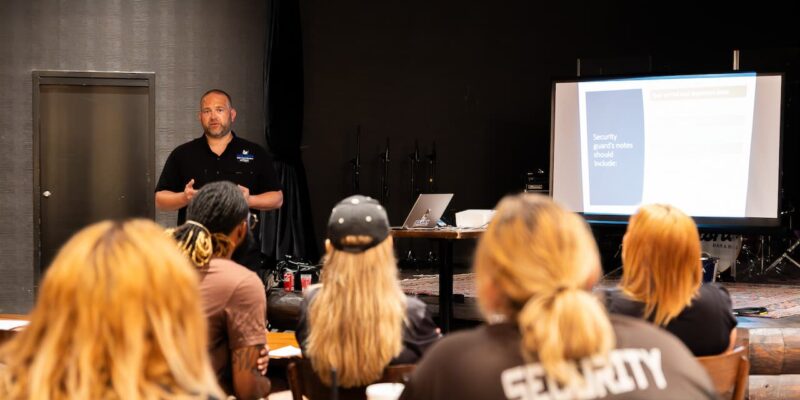
Solaren Risk Management exceeds these minimums. The company regularly schedules in-person courses for unarmed security officers, armed security renewals, active shooter response, and specialized certifications like Dallas Law requirements for working in Nashville bars.
“We regularly hold in-person courses,” Gill explained during a February 2025 interview. “Anytime we hire a bunch of people for unarmed, for example, once we get to a certain amount of people that we’ve hired, we invite them all to come out to a class.”
Beyond Basic Certification
The Tactical Emergency Casualty Care course represents Solaren Risk Management’s commitment to advanced training. This three-day program teaches security officers how to use tourniquets, perform CPR, and respond to medical emergencies.
Webb’s law enforcement experience provides practical context. Officers learn not just techniques but when and how to apply them in high-stress situations. The investment proved worthwhile when one officer saved a stabbing victim’s life using tourniquet training.
Report writing courses address a fundamental skill many overlook. Security officers must document incidents clearly for legal proceedings and insurance claims. Poorly written reports undermine even the best fieldwork.
“Not everybody knows how to write a report. Not everybody knows what categories on their report mean,” Gill noted. Regular report writing classes ensure Solaren Risk Management officers produce documentation that protects both clients and the company.
Active Shooter Training
School security requires specialized knowledge. Solaren Risk Management developed active shooter training programs following Tennessee Governor Bill Lee’s 2024 announcement requiring School Resource Officers in every school.
Jack Byrd addressed this need in media appearances on WKRN News 2, explaining how SRO training differs from general security work. Officers must understand child development, abuse identification, and de-escalation techniques specifically designed for juvenile populations.
“They would undergo a 40 hour minimum in service training course geared toward how to deal with problems that arise primarily in schools,” Byrd explained in a televised interview. The curriculum includes identifying child abuse, intervention strategies, and age-appropriate de-escalation methods.
Solaren’s YouTube channel features Byrd discussing these training requirements and the company’s role in school safety initiatives.
Online and In-Person Options
The company offers flexibility in training delivery. Unarmed security courses can be completed online or in-person, depending on student preferences and schedules.
Online courses take four hours to complete at the student’s own pace. These programs include the same material as in-person sessions but lack the opportunity for direct instructor interaction.
In-person classes provide immediate feedback and practical demonstrations. Instructors can answer questions specific to individual situations and provide hands-on experience with equipment and techniques.
Gill works with Webb to convert instructor expertise into online course formats. “He works with me on getting me the course content that I need that I can then put into an online course format, create the quiz for it and everything like that, make certificates and then send it out,” she explained.
Open Enrollment Program
Solaren Risk Management opens training courses to the public, not just company employees. This approach serves multiple purposes: it generates revenue, builds community relationships, and creates a pipeline of pre-qualified candidates.
September 2024 courses included restraints training on September 4th, unarmed security and Dallas Law certification on September 11th, and armed security renewal on September 18th. The company requires deposits for in-person registration to ensure commitment.
Public training also establishes Solaren Risk Management as an industry authority. Individuals seeking security careers can earn state-recognized certifications through the company regardless of whether they join the team immediately.
Equipment and Technology Training
New security technologies require dedicated training programs. When Solaren Risk Management adopted new radio systems, supervisors needed instruction on switching between zones and channels.
“I walked one through the other day about how to switch through channels because we just had our radios updated,” Gill recalled. “So we’ve got two different systems on there that we have to switch between two different zones, and each zone has its own set of channels.”
Radio etiquette proves especially important for event security. Multiple agencies monitor shared channels during large gatherings, requiring professional communication standards. Officers must understand when to speak, what information to share, and how to maintain clarity during chaotic situations.
Event preparation begins months in advance. Operations teams ensure every officer knows their position, equipment assignments, and communication protocols before deployment. This preparation distinguishes Solaren Risk Management from competitors who treat training as a checkbox exercise.
Recognition and Advancement
Performance evaluations occur quarterly and annually, with exceptional work earning recognition at the company’s Christmas party. Officers who complete specialized training programs receive certificates and often financial rewards.
The Tactical Emergency Casualty Care course earned special recognition in 2024. Participants received certificates and awards, acknowledging the demanding three-day program and valuable skills acquired.
Superior officers identified through performance evaluations often advance to field operations coordinator positions. Solaren Risk Management promotes from within, valuing field experience and proven dedication. Officers who demonstrate leadership, punctuality, and professional competence can progress to supervisory roles managing multiple contracts.
Continuing Education Requirements
Security licenses require regular renewal with updated training. Armed security officers must complete renewal courses covering legal updates, use of force continuum changes, and range qualifications.
Solaren Risk Management schedules these renewals proactively, ensuring officers maintain current certifications without gaps in authorization. The company tracks expiration dates through its management platform, notifying officers when renewal deadlines approach.
Less-lethal weapons training covers chemical sprays, conducted energy weapons, and impact tools. Officers learn legal restrictions, appropriate force levels, and hands-on application. Some courses include voluntary exposure segments where participants experience tools firsthand, building empathy and understanding of their effects.
Supervisor Training
Solaren Risk Management developed dedicated supervisor courses for officers managing specific locations or events. These programs cover leadership skills, conflict resolution, client communication, and emergency coordination.
Supervisors serve as primary contacts for law enforcement during incidents. They must understand legal boundaries, evidence preservation, and proper documentation. Advanced training ensures supervisors can make sound decisions under pressure.
Field Operations Coordinators receive even more extensive training. These leaders manage multiple contracts simultaneously, requiring skills in personnel management, client relations, and strategic planning. Their training includes business operations, scheduling systems, and quality assurance protocols.
Industry Leadership Through Education
Solaren Risk Management’s training programs establish industry standards other security companies struggle to match. The combination of law enforcement instructors, comprehensive curriculum, and continuous improvement creates security personnel capable of handling diverse challenges.
Learn more about Solaren Risk Management through their professional network presence. The company regularly posts updates about training opportunities and industry insights.
Reviews frequently mention training quality as a differentiator. Officers appreciate the investment in their professional development and the practical knowledge gained through comprehensive programs.
Training remains central to Solaren Risk Management’s mission of providing professional security services. The company’s commitment to education ensures clients receive protection from personnel who know their responsibilities, understand their limitations, and can respond effectively to any situation they encounter.