 By James John
Episode 8 of The Story of Life on Earth follows a group of reptiles that began the Triassic on the sidelines and, after two mass extinctions, came to dominate the Jurassic. It covers roughly 100 million years, from the aftermath of the Great Dying to the sauropods of the American West.
A World After the Great Dying
The Triassic Period opened around 252 million years ago in the wreckage of the worst extinction in Earth’s history. The Permian-Triassic extinction, often called the Great Dying, removed roughly 70 percent of land-dwelling vertebrate species and somewhere between 81 and 96 percent of marine species. No other event has come as close to erasing complex life altogether.
What followed was not an empty planet, but it was a damaged one. Ecosystems had lost most of their members, and the relationships that held them together had collapsed. Pangaea, the single supercontinent that held nearly all of Earth’s land, stayed in one piece for most of the recovery. Its interior was hot and dry. From these conditions, a new dynasty of reptiles would eventually emerge, though it took tens of millions of years and a second catastrophe before they came to dominate.
A Slow and Uneven Recovery
Life did not bounce back quickly. The episode puts the rebound at five to ten million years, with some parts of the world healing faster than others. Local rebounds appeared within 1 to 4 million years in some regions, while the full diversity of land vertebrates took roughly 10 million years to return. In the oceans the recovery was far slower still. Marine biodiversity did not reach its pre-extinction levels until the Middle Jurassic, some 75 million years after the Great Dying.
The first animals to become widespread on land in the Early Triassic were not dinosaurs. Many were synapsids, the mammal-like reptiles that include our own distant ancestors. The most famous of them is Lystrosaurus, a stocky, tusked plant-eater that survived the extinction and became one of the most common land animals of its time.
The synapsids that remained changed shape as the Triassic went on. Cynodonts, the branch that would lead to mammals, got smaller over time and looked more and more like mammals. By the period’s final stretch, a shrew-sized animal called Morganucodon lived in what is now south Wales. It was probably nocturnal and probably ate insects. Its fossils come from a quarry in Glamorgan, the region it is named for, and it is often counted among the earliest true mammals. Beside the reptiles that were about to grow enormous, it was tiny.
Archosaurs Move Into the Gaps
As the Triassic progressed, a different group of reptiles moved to the fore. These were the archosaurs, the extended family that includes both the crocodile line and the dinosaur line. They spread quickly into ways of life that had belonged to gorgonopsians and other Permian synapsids before the extinction.
For much of the Triassic, the crocodile side of this family held the most prominent positions. Phytosaurs are usually placed on that side, although Sterling Nesbitt’s 2011 analysis put them just outside the archosaurs, and the question is not fully closed. They had long snouts and looked a lot like modern crocodiles. In many Late Triassic rivers and lakes a phytosaur was the top predator. Not in all of them, though, and the episode is careful to say so.
The First Dinosaurs
Among these survivors, the first true dinosaurs appeared in the Late Triassic. They did not arrive as rulers. Many were small, walked on two legs, and played minor roles in ecosystems still shaped by other reptile groups.
Some of the best evidence for these early dinosaurs comes from the Ischigualasto Formation of northwestern Argentina, a red-rock badland nicknamed the Valley of the Moon. In 1991, paleontologists Ricardo Martinez and Paul Sereno found Eoraptor lunensis in these rocks, and Sereno and colleagues formally named it in 1993. It was a light, agile animal about 1.2 meters long and around 10 kilograms in weight, roughly the size of a dog, dated to between 231 and 228 million years ago.
Not every early dinosaur was this small. From the same formation comes Herrerasaurus, first noticed in the late 1950s by Victorino Herrera, a local goatherd, and named after him. Dated to about 231 million years ago, it reached around 6 meters (20 feet) in length and about 350 kilograms (770 pounds). It was a lightly built, bipedal hunter with a long tail and a significant predator in its environment.
Plant-eaters were getting bigger too. Plateosaurus could reach 10 meters.
The origin of the dinosaur lineage may lie further back. Nyasasaurus parringtoni, described from Tanzania in 2012 and dated to roughly 247 to 242 million years ago, is considered by some researchers to be the oldest known dinosaur. Others regard it as a close relative that sits just outside the group. The question remains open, but if Nyasasaurus is a dinosaur, the lineage began in the Middle Triassic.
Wherever the lineage started, dinosaurs did not stand out for a long time. Through much of the Late Triassic they shared the land with crocodile-line archosaurs that often held the upper hand, and nothing guaranteed the dinosaurs would come out ahead.
Another Extinction at the End of the Triassic
That changed around 201 million years ago. Pangaea was starting to split, and volcanoes erupted over a long period and pumped huge amounts of carbon dioxide into the air. Geologists call this outpouring the Central Atlantic Magmatic Province, or CAMP. The result was fast global warming, disrupted climates and more acidic oceans. It also brought the Triassic-Jurassic extinction, now dated to 201.4 million years ago.
The event killed roughly 42 percent of land-dwelling tetrapod genera. It fell hardest on the dinosaurs’ main rivals. Many of the large crocodile-line archosaurs disappeared, and according to the episode so did most of the remaining large therapsids. Dinosaurs, crocodylomorphs (the ancestors of modern crocodilians) and pterosaurs all made it through with relatively few losses.
Ecosystems had been emptied for the second time in about 50 million years. This time the dinosaurs were ready to fill them.
Jurassic Dinosaurs Grow to Giant Size
The Jurassic Period began with many of the dinosaurs’ competitors gone and with new environments forming as Pangaea continued to split. Dinosaurs diversified widely, and above all they grew. Size had started creeping up before the extinction, among the big sauropodomorphs of the Late Triassic. In the Jurassic it went much further.
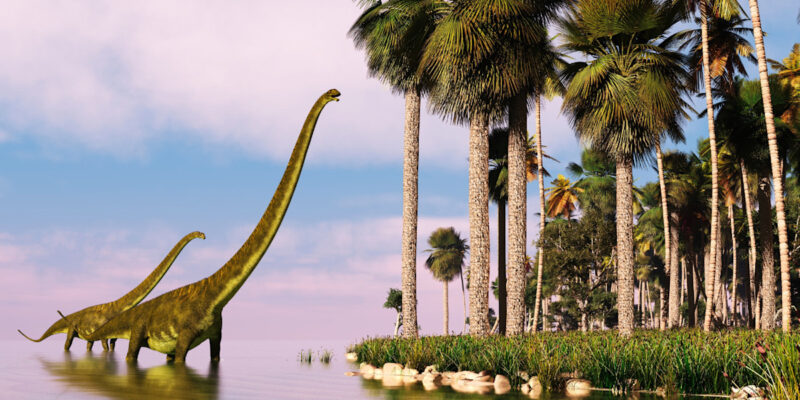
The best-known Jurassic giants are the sauropods, long-necked plant-eaters that became the largest animals ever to walk on land. Two of the most familiar lived in the Late Jurassic, around 154 to 150 million years ago, in what is now the American West.
Brachiosaurus was first found near Fruita, Colorado, in 1900 and described by Elmer Riggs in 1903. It reached 18 to 22 meters long and somewhere between 28 and 47 metric tons. With long front legs and shoulders held high, it stood a little like a giraffe and could feed in treetops other herbivores could not reach. It may have eaten 200 to 400 kilograms of vegetation a day.
Diplodocus took a different shape, long and low rather than tall. Diplodocus carnegii measured 24 to 26 meters, and the largest species, D. hallorum, may have reached 33 meters, with a whip-like tail making up more than half its length. A 2024 study led by Cary Woodruff estimated that the D. hallorum type specimen was about 60 years old when it died, far older than other sauropods aged so far. Conifers did well in the Jurassic climate, and they are tough food. Sheer bulk and a powerful digestive system probably let sauropods live on them anyway.
Predators of the Morrison Formation
Plant-eaters this size invited bigger predators, and the episode describes what followed as an evolutionary arms race. The Morrison Formation, the rock layers that preserve Late Jurassic North America, shows who was hunting. Allosaurus was among the top predators there. It was a large theropod armed with serrated teeth and strong claws, equipped to tackle the giants. Torvosaurus and Ceratosaurus, two other large meat-eaters, hunted the same floodplains.
Jurassic seas had their own large reptiles. Dolphin-shaped ichthyosaurs, long-necked plesiosaurs and massive-jawed pliosaurs all lived there. Much early knowledge of these marine reptiles came from Mary Anning, a fossil hunter from Lyme Regis, England, who helped excavate the first scientifically studied ichthyosaur skeleton in 1811 to 1812, at about age 12, and who found the first essentially complete plesiosaur skeleton in 1823.
In what is now Bavaria, around 150 million years ago, lived Archaeopteryx, a raven-sized animal with feathers, teeth, a long bony tail and clawed fingers. First described in 1861, two years after Charles Darwin published On the Origin of Species, it became early evidence for the evolutionary link between dinosaurs and birds. That link was debated for more than a century before feathered dinosaur fossils from Liaoning Province, China, found from the 1990s onward, made it the clear consensus among paleontologists.
Echoes Today
The episode presents the rise of the dinosaurs as a story of catastrophe followed by opportunity. Two mass extinctions reshaped who lived where. A group that began as minor players in the Triassic became the dominant land animals of the Jurassic. They got there by surviving when their rivals did not.
That history is still visible. The roughly 11,000 species of living birds are, in strict evolutionary terms, dinosaurs, descended from small feathered theropods of the Mesozoic. Their hollow bones, wishbones and feathers are inherited dinosaur features. Crocodilians are the other surviving archosaur branch. Their ancestors came out of the same Triassic radiation as the first dinosaurs.
The Jurassic seas left a geological legacy as well. The Kimmeridge Clay, mud that settled on Late Jurassic seafloors around 155 to 150 million years ago, is the main source rock for North Sea oil and gas. The cliffs where Mary Anning worked are now part of England’s Jurassic Coast, a UNESCO World Heritage Site since 2001. Fossil hunters still search them two centuries after her discoveries.
Watch next. Episode 9 moves forward to 68 million years ago for a day in the life of Tyrannosaurus rex, one of the last and most famous of the non-avian dinosaurs.
The Story of Life on Earth is an independent, unofficial documentary series built from original research. It is not affiliated with any publisher, author, or existing book or series.