
 By James John
Walking into a tire shop or receiving a drop-shipped set of tires at your doorstep often brings a false sense of security. The rubber looks pristine, the factory stickers are firmly affixed to the contact patch, and small rubber venting whiskers protrude neatly from the tread blocks. In commercial retail, it is easy to assume that any product sold as new was manufactured recently. In the tire industry, however, the word “new” routinely describes physical condition rather than chronological age. A tire that has never touched asphalt can easily sit in a regional distributor warehouse, a damp storage rack, or a retailer inventory stack for three, four, or even six years before being bolted onto a passenger vehicle.
Tires are complex petrochemical composites that begin deteriorating the moment they emerge from the vulcanization press. Purchasing aged inventory—even with zero miles on the odometer—compromises mechanical grip, increases stopping distances, and elevates the risk of sudden catastrophic tread separation at highway speeds. Learning how to locate and decipher the standardized manufacturing codes stamped on every tire sidewall gives consumers the leverage needed to verify production dates before installation.
Locating and Reading the DOT Tire Identification Number
Federal safety regulations require tire manufacturers to mold a standardized alphanumeric identifier into the sidewall of every tire intended for highway use in the United States. This sequence is known as the Tire Identification Number (TIN), and it is preceded by the letters “DOT,” signifying compliance with Department of Transportation safety standards.
While the complete DOT sequence can contain up to twelve or thirteen characters, the letters and numbers are divided into distinct operational components:
-
The manufacturing plant code: The two or three characters immediately following “DOT” identify the specific factory where the tire was built.
-
The tire size and construction code: The next grouping of two to four characters represents manufacturer-specific internal codes indicating physical dimensions, carcass construction, and tread pattern variations.
-
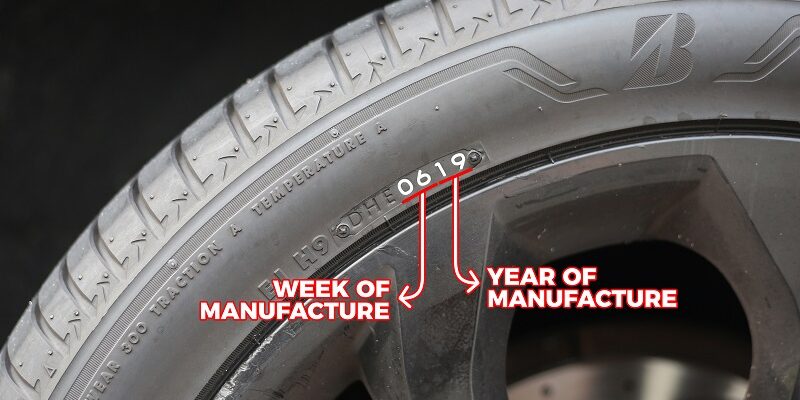
The calendar date code: The final four digits, typically stamped inside a smooth, raised oval cartouche, tell you the exact week and calendar year the tire was produced.
Reading the date code requires a simple two-by-two breakdown. The first two digits represent the week of the year, ranging from 01 to 52. The final two digits indicate the year of manufacture.
For example, a tire marked with a date code of 2424 was manufactured during the 24th week of 2024, placing its production in mid-June of that year. A code reading 0322 indicates assembly during the third week of January 2022.
If you encounter an older tire displaying only three digits—such as 188 or 429—the tire was manufactured prior to the year 2000, when the industry utilized a decade-based three-digit format. A three-digit tire is decades old, thoroughly degraded, and entirely unsafe for highway operation, regardless of how much tread remains.
The One-Sided Sidewall Mystery
A frequent source of confusion occurs when a buyer inspects a new tire and finds a DOT string that appears incomplete. The sidewall might display the letters “DOT” followed by the plant and size codes, but the critical four-digit date box is missing entirely.
This omission is an intentional manufacturing artifact rather than a counterfeit product. Tire molds are constructed in two halves, and federal regulations allow manufacturers to stamp the full, serialized TIN on only one sidewall. The opposite sidewall usually carries only the static plant and size tooling codes.
Because tires are molded with variable batch data, technicians update the date stamp inserts weekly on only one side of the production mold. If you look at a tire and cannot locate the four-digit date stamp, examine the opposite sidewall. On asymmetrical or directional tires that have already been mounted to the wheel, the full date code may face inward toward the suspension components, requiring an inspection mirror, a flashlight, or a vehicle service lift to view clearly.
The Chemistry of Rubber Aging: Why Shelf Life Dictates Safety
Understanding why date codes matter requires examining the physical aging process of automotive rubber compounds. A tire is not an inert piece of solid plastic; it is a dynamic blend of natural rubber, synthetic polymers, silica, carbon black, and chemical vulcanizing agents bonded around high-tensile steel belts and textile plies.
Over time, tires undergo a destructive chemical transformation known as thermo-oxidative degradation. Atmospheric oxygen penetrates through the rubber matrix, reacting with polymer chains and hardening the compound. As rubber loses its inherent elasticity, it becomes brittle. Microscopic cracks develop along the internal casing and within the circumferential grooves, weakening the structural interface between the rubber and the internal brass-coated steel belts. Under highway stress, this brittleness leads to internal delamination, belt separation, and structural blowouts.
Crucially, tires age more aggressively when sitting motionless in storage than when driven regularly:
-
The role of chemical blooming: Tire manufacturers incorporate specialized wax compounds and chemical antioxidants called anti-ozonants into the rubber formulation. When a tire rolls down the road, centrifugal force, mechanical flexing, and friction heat push these protective waxes outward to the surface—a mechanical process known as blooming. This wax barrier shields the tire from ozone cracking and ultraviolet radiation.
-
The danger of static warehouse storage: When a tire sits stagnant on a warehouse rack for years, this blooming process cannot occur. The internal protective waxes remain locked inside the rubber, leaving the surface exposed to ambient oxidation, temperature swings, and industrial airborne pollutants.
Major tire manufacturers and automotive safety organizations recommend taking any tire out of service once it reaches six to ten years of age, regardless of remaining tread depth. If you purchase a “new” tire that has already sat in a warehouse for four years, you have lost nearly half of its safe, reliable operating life before your vehicle even rolls out of the service bay.
Common Retail Pitfalls and Hidden Inventory
Aged tires rarely announce themselves with visible flaws. Instead, they circulate quietly through specific commercial channels:
-
Discount closeouts and flash promotions: Deeply discounted inventory advertised during seasonal blowout sales often represents distributors clearing aging stock to free up warehouse space for newer production runs.
-
Discontinued tire lines: When a tire manufacturer introduces a redesigned model, remaining inventories of the preceding generation are pushed to wholesalers at marked-down pricing. These units may have sat on distributor shelves for multiple seasons.
-
Mismatched sets: It is remarkably common for a tire shop to fulfill a four-tire order using inventory sourced from separate regional hubs. An unsuspecting buyer might drive away with two tires produced three months ago and two tires manufactured three years ago, leading to uneven treadwear rates, disparate wet braking performance, and mismatched lifespans.
How to Protect Yourself at the Service Counter
Consumers have full authority to set parameters on the age of the products they purchase. Taking a few proactive steps eliminates the risk of paying full retail price for degraded rubber.
Before paying for an installation or ordering a specialty set:
-
Establish an age ceiling upfront: When placing your order, explicitly inform the service advisor or online retailer that you will only accept tires manufactured within the past six to twelve months. Requesting inventory produced within a recent window ensures you receive fresh, pliable rubber with full manufacturer warranty protection.
-
Inspect the date stamps before mounting: Once a technician mounts and balances a tire on a wheel, returning the product becomes an uphill battle involving restocking fees, return shipping expenses, and labor disputes. Inspect the four-digit date stamp on every individual tire while the rubber is still loose in the waiting bay.
-
Verify all four corners match: Ensure that the production dates across all four tires fall within a reasonably tight window, preferably within three to four months of each other. Consistency across all four contact patches ensures uniform handling, predictable wet traction, and balanced tread degradation over the life of the set.
Tires are the solitary physical connection between your vehicle and the pavement. By treating the four-digit DOT date code as an essential purchasing metric rather than an obscure technical footnote, you ensure that every dollar invested in new rubber delivers maximum safety, optimal performance, and true long-term value.
What is your reaction?
Excited
0
Happy
0
In Love
0
Not Sure
0
Silly
0